Showing posts with label antique wheel. Show all posts

21 July 2013

Spinning at the Garden

Today I was at the local Garden - it’s an old homestead that was made into a historical site: the old house is still there, and the guy who homesteaded there originally was determined to grow all kinds of plants. There are trees there that “shouldn’t” grow here, like a black walnut and some others .. the crazy guy even imported poison ivy (it doesn’t grow here) to see if it would grow! (It does! It has a big fence around it, but it grows here!)

Anyway, today was ”History in the Garden”, celebrating the centennial of the homestead, and I was there doing a spinning demo on my 100 year old wheel … in period costume (or close to it) and spinning rovings done at Custom Woolen Mills, here in Alberta, which uses equipment from around the turn of the century as well.

Photo 2013-07-21 11 33 30 AM

So I was at my wheel all day - and I spun up another 4 bobbins of singles, so about 400 grams more.

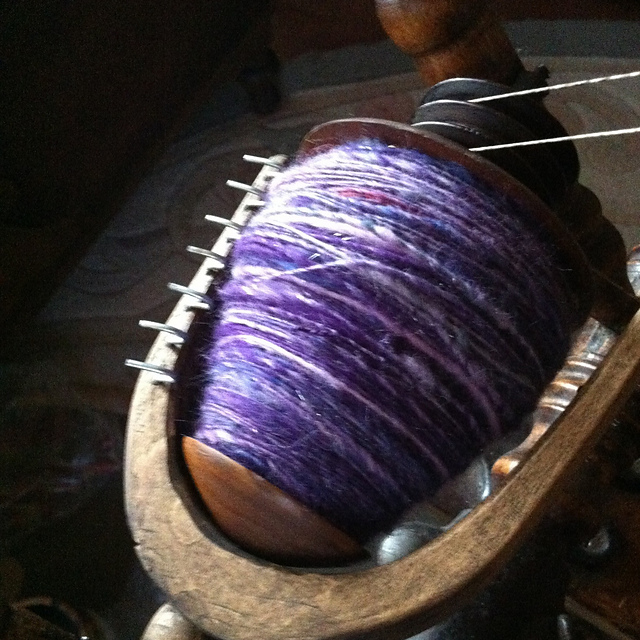
Photo 2013-07-21 6 29 20 PM

It’s nothing special - it was some random CWM rovings I found in my stash, don’t even know what it is, but I know it’s their stuff, I recognize the characteristic structure of the rovings - but it’s another 400 grams of wool spun up during the Tour, which officially ends today.

Oh - and today I also sold two books, a knitted scarf, and two balls of my Tour yarn, which I had on display and a lady asked if I’d sell it. :)

So yep, I had a fun day, even if I was spinning in shoes (shoes!?? at the wheel??!). The rhubarb punch was good, too! :)

12 July 2013

Good Things: Tour de Fleece

It’s always important to balance the hard discussions with some easier ones, so let’s talk about the Tour de Fleece! After all, fibre arts are the biggest part of most of my days – I love making beautiful things, and encouraging others to make beautiful things with whatever talents they may have, too!

I love the Tour. It’s a chance to focus on spinning (or other fibre arts, but I generally go with the spinning) – which for me means getting some extra rest time in, which I really need after such a busy June. My goal this year is to spin a kilogram of Frazzlebatts during the Tour, which started June 29 and ends July 21.

So far, I have done 400 grams – I kind of got on a roll yesterday and filled two bobbins on the CPW, I was in a wheel spinning kind of mood. I finished off all the batts I’d originally carded up, then went upstairs and made more! Having a Batt Bar in your house is a wonderful thing, really.

I did a bunch of this blue stuff: it’s a mix of fibres from the stash and had some really textured stuff in there, so it came out a bit on the hairy side when it was spun. I think it’ll weave up into something neat though, maybe a bag or a tablet case type thing.

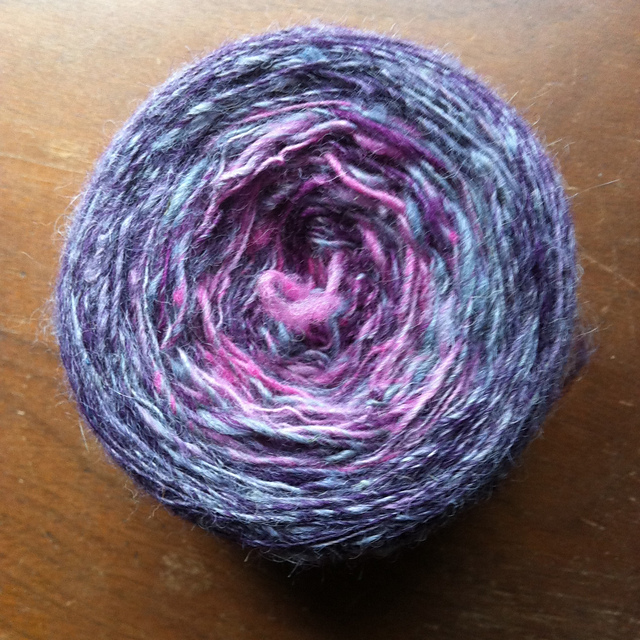
Here’s all that blue, wound into balls, plus the big fuzzy pink and purple batt all spun up:

Then I had two smaller batts made from some really soft something or other found in the stash (it might be alpaca) blended with some mohair locks and some Corriedale. There are two different batts here, I just spun them one after another and squashed them both onto the bobbin, then wound off into a ball – you can see the colour change in the middle.

Then I had to card up more batts … I’m in a pink and purple kinda mood, mostly, but I got some really nice new green shades for the Batt Bar so I had to try those out as well:

And I couldn’t resist the sparkly purple one, so it got spun up too!

Today I think I’m gonna be doing some more knitting: I’m working on a vest design with some yarn I got at Fibre Week from the lovely people at Riverstone Yarns: it’s their gorgeous mohair blend, and the colours are just amazing! I should have something photographable by tomorrow.

It’s a lovely, sunny, breezy day here at Apple Jack Creek – I hope you are having a beautiful day where you are, too!

15 June 2013

Ontario, Day 6

I should be sleeping, but the adrenaline rush is still on full blast so I might as well post today’s update while the valerian/hops blend kicks in!

The great news is that I slept 7 solid hours last night, which I desperately needed, so that was awesome as I was then able to face (and enjoy) the day.

First thing this morning I went down and got a cup of tea, and poked my head in the door where the conference session was on. The organizer person at the door said I should go in and participate if I wanted to, so I got to play! The theme of the conference is “spinning tales” and we were given an excerpt from a book and fibre to spin a yarn that somehow went with our story. I had the bit from the first Harry Potter book where Harry is at Hogwarts for the first time – the dining hall with the sparkling candles in midair, the silvery ghosts, and the ceiling that shows a sky spangled with stars. That was fun to spin!

Photo 2013-06-15 9 42 40 AM

As I was heading out of the seminar, I saw this wheel:

Photo 2013-06-15 10 25 36 AM

I stopped dead in my tracks, set down all my stuff and dug out my camera because I had to have a picture of it! I found the owner later on – her husband made the wheel for her, it’s really (REALLY) impressive. I hear he may be doing custom orders … I have contact info, email me if you want it. :)

Then it was time to get things going in the market. A lady brought a double flyer wheel for Wheelwright to have a look at:

Photo 2013-06-15 12 31 31 PM

(That swift in the foreground is an actual antique that was repaired – it’s got new bars, but the upright and screws are original. Yes, it’s for sale.)

There were a lot of gorgeous wheels.

A Paradis with the original pumpkin paint (in fabulous shape, boy does this thing spin beautifully):

Photo 2013-06-15 12 32 39 PM

A reproduction CPW done in pine; a very old, very wonderful (really, really wonderful) screw tension wheel that was at some point painted (or partially painted) blue; a Bisson that isn’t quite fully refinished yet…

Photo 2013-06-15 12 32 46 PM

A lovely little flax wheel, a marked Philias Cadorette, and you can just see the leg of a really cute little child’s wheel (which is part of Wheelwright’s personal collection). All but the baby wheel are looking for homes, and I spun on every one of them and loved them all! It’s a good thing I came here on a plane. That pumpkin wheel or that once-blue-screw tension would probably find their way into my car if it were here.

Photo 2013-06-15 12 32 49 PM

So my purpose here was to spin on the wheels and help folks who wanted to try them out. Basically, I got to sit around and play with gorgeous wheels and talk to people … it was awesome!

My aunt and uncle came down from Brampton and we got to visit for part of the morning and then have tea during our midafternoon break. I never did get a picture, we were too busy chatting and having a good time, but boy oh boy was it wonderful to see them. It’s been way too long.

We convinced other spinners to test the wheels (see, Aunt Sharon? she spins barefoot too!)…

Photo 2013-06-15 12 42 22 PM

And I spun and plyed up 100 grams of lovely black fibre. When I had the bobbin all filled up, Wheelwright suggested we skein it up on the antique swift. Now, I’d been sitting there spinning and chatting to this lovely gentleman who told me, after some time, that his career was making spinning wheels.

I was sitting next to Gord Lendrum. Yes, *that* Gord Lendrum.

So, my yarn was skeined by the man behind a Canadian wheel manufacturing company and a wheel repair expert, while I stood there and watched.

photo (2)

They even wound it into a ball when it was time to pack up for the day.

Photo 2013-06-15 5 33 42 PM

Do I have an awesome life or what, eh?

In the evening there was a dinner and a fashion show (inspiring, as always) and then a spin-in … during which I spun up another bobbin full of yarn and plyed it, this time on a marked Dejsardins. Yep, it’s been a fun day.

Tomorrow morning Wheelwright is doing his keynote speech, all about assessing and repairing/restoring antique wheels. I’ll be operating the camera that will be used to project the detailed view of what he’s discussing (a part of the wheel, for instance) onto the screen so that everyone in the room can see even if they are at the back.

I suppose that means I should get some sleep, since I need to be downstairs in about seven hours. Uh, make that six.

Tomorrow is another busy day – conference in the morning, train in the afternoon, visiting with some of my Chosen Family in the evening … then sleep fast and get on the plane to go home the day after! What a whirlwind this trip has been … but it’s been a wonderful time.

Seeing my family was just like coming home, didn’t seem like anything really out of the ordinary, we were just … all together. Like it ought to be. It isn’t like that very often though, and I’m really, really glad I came … because I have so enjoyed being with everyone ‘for real’. Add to that the chance to meet Wheelwright after four years of online friendship, to play with lovely wheels and meet wonderful people and make pretty string (all at once!), see my aunt and uncle, and see one of my very best friends and his family … and well, things just don’t get much better than that.

I’m very blessed, and very grateful.

14 June 2013

Ontario Days 4 & 5

I’m (finally) feeling tired so this’ll be brief.

We went to St Jacobs, where we met up with my sister and her husband, and checked out the market and the antique stores and the Home Hardware museum and a fabulous quilt/fibre arts shop and lots of other neat things.

The information centre in Leamington is shaped like a tomato. This, of course, is because the Heinz factory is in town. Leamington is all about tomatoes!

Photo 2013-06-13 7 42 15 AM

The tablecloth at this produce booth was hand woven:


Photo 2013-06-13 11 33 56 AM

Neat stuff at the hardware museum:

Photo 2013-06-13 3 59 32 PM

That was Thursday. We spent the night in a little B&B out in the country … which is different than the Alberta definition of ‘out in the country’ in that the roads are paved and you can do 90 km/h (if it is in an area with few Amish, who still use horses & buggies to get around). I woke up early and went outside to try and walk some sense into my body and saw this:

Photo 2013-06-14 6 03 19 AM

We all went to St Mary’s where there is a lovely river and some spots where there used to be large waterwheels, to power grinders or what have you.

Photo 2013-06-14 2 01 13 PM

Look, it’s my family at the Thames River:Photo 2013-06-14 2 14 28 PM

Then everyone headed off in different directions – me to the fibre conference with my friend Wheelwright, my parents to visit an old friend who lives in a seniors home (Dad plays the piano for her and it makes her very happy), and my sister and her husband to head home.

Here’s Wheelwright spinning on one of his restored antiques – this one is from about 1860 he figures, and it’s amazing. Awesome to spin on.

Photo 2013-06-14 7 46 07 PM

And I am, finally, tired enough to sleep … so I shall go do that and I’ll tell you more about the conference and the wheels tomorrow.

10 February 2013

Pink. Purple to be added shortly.

The PTSD fatigue has, up until recently, kept me too tired to spin at the wheel (thank goodness I found supported spindles - I can still spin, even when I’m too tired to treadle!) … but today, the mood finally struck. Jacqueline and I decided to play.

I spun two bobbins of hot pink hand dyed Tunis (actual woolen prep rovings from the local mill) - about an hour per bobbin.

image title

I was aiming for something I could use in a 2 ply for socks, and I think I got it. I plyed on my Norwegian (since she has no issues going backwards, and that meant I only had to wind off once onto a Lazy Fred storage bobbin). The finished yarn is now back in the dyepot soaking up some splotches of purple.

Ah, here we go: out of the dyepot.

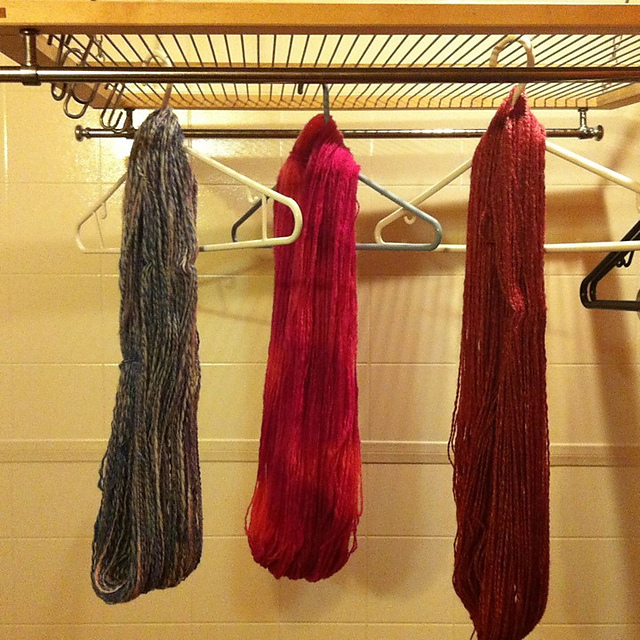
Left to right: great wheel spun blues plyed with spindle spun whitish singles; hot pink and purple sock yarn; garnet silk/merino, spindle spun.

Pink and purple splotch socks.This should be a decent antidote to the muck and slush of the (hopefully) upcoming spring season. :)

(Spring in northern Alberta is NOT something to rhapsodize about. It’s messy. It takes too long. I want to go from 2 feet of snow to summer in two weeks, but it takes two months. Of muck. And grayness. Pink will help.)

22 August 2012

Whappity Things for Paint Removal

I've been working on a lovely Norwegian wheel recently, removing some truly horrid deck stain that some well-meaning but clearly clueless muggle used to cover the gorgeous wood.

Believe me, it's hideous. Worse in real life than the pictures convey.

Anyway, six hours and a litre of nasty chemicals later, most of the stain was off. However, there's always those bits of melted finish and the stuff stuck in the cracks and crevices. I really wasn't looking forward to another few hours with the nasty chemicals, nor was I liking the idea of having to floss the crevices with yarn soaked in paint thinner (though I will probably end up having to do that on a couple of spots regardless, it's not really my idea of fun).

So, I checked the Dremel accessories and I found awesome whappity things: abrasive (mild, medium, strong) wheels of rubbery stuff with abrasive built into it, and buffing wheels that look sort of like an afro hairdo. I burned through one of the medium abrasive wheels and two of the buffing wheels in two hours this afternoon, but the majority of the leftover paint bits (as well as some stain I hadn't gotten with the chemicals) came off - and no damage to the wood. No scratching or dulling of the edges of the turnings noticeable.

They aren't cheap - I think the abrasive wheel (which lasted most of the two hours and was probably the ideal tool for the job - though I probably could've gone with the heavier abrasiveness for some of this work) was just over $10, and the pair of buffing things were about $5. Still, waaaaaaaaaaaay better than the fumes and I was able to get into the cracks and crevices in ways I just can't manage with a rag and the big bulky gloves that I have to wear when using those nasty chemicals (even *with* my big heavy gloves, my hands were stinging a little by the time I was done).

So there’s another tool added to the arsenal: shellac comes off so easily, there's no need for anything like this, but when you are facing a muggled paint/stain job and need the big guns, this might be worth considering.

14 August 2012

Norwegian Wheel Restoration Project

I was asked by a local spinner to see what could be done with a lovely wheel she acquired awhile back … a job I’m always happy to take on!

The wheel is a Norwegian split table design – like the one I recently got in a trade, but this one’s an actual antique whereas mine’s a vintage reproduction.

The wheel itself is in really good shape – the wheel is well balanced and not warped, the flyer is intact (though a few hooks are damaged or broken), the bobbins (yes, it has three!) have chips in the whorls but at least two of the three could be used as-is, and with a quick twist of the uprights to align the wheel with the flyer, we had it up and spinning within 30 minutes of me setting eyes on the beauty.

Now, the bad news is that someone plastered this gorgeous wheel with what I can only assume is a version of deck stain – some nasty pale brown opaque stain that covers most of the wood grain and makes the whole thing look blah and wrong. What on earth would possess someone to cover up beautiful wood grain with such an ugly stain? We’re not talking about a deck or a picnic table here that needs protection from the elements … it’s a spinning wheel!

This is what was on the wheel to start with:

The picture doesn’t do it justice. It was truly horrid. The wheel, though, is beautiful, even with that washed out finish covering the wood:

Six hours and a litre of nasty chemicals later, we have this:

Look! Wood grain! And can you see the captive ring on the rear cross bar? There are more on the Mother of All (the thing that holds the flyer) too!

Captive rings show off the work of the woodworker who turned the piece – a circle of wood is shaved off from the base, but kept intact around the shaft, like a bracelet. There are four rings on the horizontal piece under the flyer – I’ll have to get better pictures.

The wood looks terrible after the chemical bath, but it is still so much prettier than with that horrid beige stuff on it, I cannot even begin to imagine why anyone would’ve thought the wheel would look *better* slathered in that gunk. I need to get a new attachment for my Dremel (a ‘whappity thing’) to help get rid of the remaining residue from the stripping job, then I will be able to refinish with Watco Natural and show off all that gorgeous wood.

I think this wheel is really very old – it’s all pegged together, the only metal is the flyer rod and the hooks, and the bar that the treadle rotates on. I’ve put out some queries on Ravelry so we’ll see if anyone knows more – but it is an absolutely lovely wheel, and I am honoured to have a chance to work on her!

04 July 2012

Meet Anne

This lovely Norwegian split table wheel is named Anne, or so her previous owner tells me. My grandmother was named Anne, and so it seems quite fitting that this wheel should have found her way to me.

Anne came here through an interesting route: my Ravelry profile describes my addiction to antique wheels, and mentioned that the only type of wheel that I truly  longed for that I didn’t yet own was a Norwegian split table wheel. A friend of mine saw this and realized she had exactly the sort of wheel I was looking for languishing, unloved, at her house. She’d gotten it for a great deal at an antique store (that’s extremely uncommon – antique stores tend to sell wheels with missing pieces for ridiculously high prices, and this one is in perfect working order and was only $60!), the wheel needed to find a new home, she knew I’d like it, and she was coming to Olds for FIbre Week and would bring it to me.

All she wanted in exchange was fleece.

Wow.

Fleece I have, so we swapped wheel for fibre and Anne is now in my living room getting good use already. She needs another coat of oil, the ends of the boards where the stain soaks into the end grain are looking kind of dry, but she spins beautifully (in both directions – meaning she’s great for plying, too!) and is so lovely to look at. She’s probably not all that old, judging by the wood, but she’s completely pegged together. There are two tiny screws in the tips of the flyer arms, which is something I’ve not seen before … I’m not sure why they are there, maybe for weights or something.

The turnings are fine and delicate, the leathers are in great shape, and she’s just a wonderful piece of spinning gear. I’m so honoured to have her here!

If you’ve seen one like her, please let me know – I’m very curious to find out where she came from … she has no markings at all!

09 May 2012

Other neat things seen at the auction

None of these came home with me, though I know that the double treadle CPW went to a spinner and I suspect the other two did as well. :) They were really interesting wheels, so I thought I’d post the pictures.
Here’s the double treadle CPW. Not sure about the little foot pad thingies, but it was in really good shape except for a smashed up bobbin end. Went for $550 or thereabouts.
image title
This one looks like what we usually call a CPW precursor, I think - screw tension, but the rest of the wheel looks very CPW like. This one was missing a whorl but had everything else. It went for around $150, if I remember rightly.
image title
And this one just fascinated me: flat rim, but Vizina tilt-tension mechanism. It had no flyer, just the spindle from a GW stuck in it, though the leathers were obviously meant for an ordinary flyer. I don’t recall seeing a tilt tension wheel with a flat rim before, it’s really nice looking. A bit of oil and she’d be gorgeous.
image title
I looked very closely and there was no hint of a maker’s mark, and it didn’t seem cobbled together at all - everything seemed to belong together. Super cool.
While I was watching the auction, I got this done:

I had to be very careful to draft sideways, rather than reaching up like I usually do, so that I didn’t accidentally bid on anything!

14 April 2012

More from Grandma Shirley the Great Wheel

I’ve been doing more spinning on the great wheel, as I have been feeling inclined to do a bit of walking back and forth in front of the fireplace.
This is what I have accomplished so far: the skein is the first ‘real yarn’ I spun on the great wheel, 152 metres of very nice, very soft fluffy yarn. The two little cones of singles are yesterday’s spinning – some of which I was working on while I did the video, and the rest of which I did up after supper. It really doesn’t take long at all to fill a cop (that’s the name for this little mini-cone, for the non-spinners in the crowd).

Today, I tried a new technique for plying: I made a plying ball. This seems like a wasteful extra step: you take the two singles and wind them together, under tension, onto something else (I used my lovely nostepinne, which is sadly underutilized now that I have a ball winder). The idea is to get the two singles lined up next to one another with all the tangles taken out before you start the plying process, which twists the two against one another. If your singles are stored on bobbins, and you have a tensioned lazy kate, this is not a big issue as the tension on the bobbins tends to keep the excess twist that singles need to have under control. With the singles just on a cone of paper, though, they were a bit unruly, and taking the time to wind up a plying ball made the process of plying at the wheel extremely relaxing.
I suspect that it takes the same amount of time, overall, but the frustration level is less: when I’m plying on the great wheel, I have my singles on the floor, and I’m not able to keep them evenly under tension like I do when I’m plying from my Lazy Fred or my shoebox kate at the wheel, as I keep moving around, changing the amount of tension on the yarn between my hand and the bobbins on the floor. So, the plying ball takes just a little bit of time and then I can dance at the wheel, my rhythm never interrupted by tangles in the yarn.
Here’s the second batch of yarn, measured out on the awesome PVC niddy noddy my father-in-law made for me:

The second skein is now hanging up to dry (giving the finished yarn a somewhat abusive bath in hot and cold water then whacking the skein on the bathtub several times really improves the finished yarn). This batch came out to 105 metres of yarn, so that’s 257 metres overall, spun in remarkably little time, and I’m quite happy about it. That’s enough yarn to do a pair of socks or mittens, a decently slouchy hat, a smallish shawl, or a child’s vest. Or a teddy bear.
I’ve lots more to spin though, so who knows what this will end up becoming!

13 April 2012

First person spinner video

The Boy has a really cool little camera that you can wear on a headband to take video of exactly what you are seeing (crazy people also mount them on their surfboards, or to their helmets when jumping off the sides of mountains with funky flying squirrel parachute suits, but I digress).

In probably the most sedate subject matter this particular camera has ever been applied to, I did a ‘first person spinner’ video of spinning on the great wheel. There are some lovely videos out there already – including this favourite of mine – but I thought that a close up of what the spinner sees and does with the fibre might be useful. Drafting with just one hand is a bit of a tricky thing to master, and it wasn’t until I saw this excellent video on using the Russian spindle that the pieces all clicked in my head.

And so, here’s my humble contribution to the collection of shared knowledge on the interwebs: Drafting from the Fold - Great Wheel Spinning.

Spinning on the Great Wheel, drafting from the fold

12 April 2012

Grandma Shirley gets back to work

Grandma Shirley is the great wheel that came to live at Apple Jack Creek about a year ago. She’s had her restoration work, acquired a new spindle with accellerator head courtesy of a kind Raveller, and I did a little bit of spinning on her .. though not much, really just enough to confirm that the wheel was put together properly and that I had a basic idea of what to do.
You see, to spin on a great wheel you use just one hand to control the fibre supply – the other hand is driving the wheel. Now, I do something very similar when I spin on my Canadian Production Wheel, but not quite the same: on Jacqueline the CPW, I do a supported long draw, and my forward hand is available to provide an extra nudge of pressure whenever needed. You can do this on a great wheel, but it slows things down and is frustrating if it happens all the time.
So, Grandma Shirley hasn’t gotten much use in the year she has been here.
Recently, though, I acquired a Russian support spindle and I’ve been doing a lot of spinning with it. Of course, with a support spindle, you only have one hand free to work with the fibre as well: the other hand is twirling the spindle in the dish. To use one of these ‘fancy Russian sticks for making yarn’ you put the pointed and weighted tip into a bowl of some kind (I found a couple of nice crystal dishes at the thrift shop) and spin it like a top. While it is twirling, the yarn that is twisted around and up off the pointy top end is getting more twist put into it, because of the spin of the spindle, and as you draft out the fibre with your non-spinning hand, you make more yarn. When it’s as long as your arm, you wind on. I’ll post more about this soon, I promise, it’s a wonderfully restful way to spin.
Anyway, as I was working on my spindle yesterday morning, I realized that the technique I was using would be the same thing I’d need on the great wheel, and I decided to give it a shot.
What do you know … it worked!
I was able to spin up a fair bit of yarn on the great wheel, using the skills I have practiced on my Russian spindle. In the picture below you see the Lazy Fred: it has two storage bobbins at the back containing yarn I spun on the wheel and the one bobbin lying across the stand is the first spindle full of suri alpaca / mohair blend – I wound it off the spindle and onto a Fred storage bobbin yesterday morning so I could spin some more. The Russian spindle is the pointy stick laying on the stool with more black yarn on it, and you can see the white yarn I made on the spindle of the great wheel.

Pretty neat, eh?

One of the effects of being under stress for a long time is a syndrome sometimes referred to as adrenal exhaustion. Basically, your body has made stress hormones for so long the manufacturing capabilities are all out of whack, meaning your ability to adapt to even ordinary stresses is shot until you take some time to recover. One of the recommendations for people suffering from adrenal exhaustion or recovering from long bouts of strain is to exercise gently … no hard workouts, no marathons, just gentle exercise like walking and yoga. Hard exercise (or going without food for too long, or getting overly heated or chilled) may trigger the body to think that there is a crisis, tripping the old fight or flight responses again, which is not helpful (PTSD is essentially a hyperactive fight or flight response – any little thing can send you into full blown reaction, which is not helpful when you aren’t actually being attacked). So you want to avoid tripping the crisis response, meaning you want to stay in a predictable, safe environment where your body can let go of the hair-trigger responses. Gentle exercise is part of this, and while walking back and forth while spinning on the great wheel isn’t something most people would consider exercise, it’s more than I have been doing. You take five steps back then five steps forward for every length of yarn you make, turning the wheel with one hand and reaching the other up and back and over your head then bending forward as you wind back on to the spindle. All that movement does add up … and it’s more exercise than I have been getting, so it’s an improvement even if it isn’t much of a workout. As the weather starts to improve I’ll be out in the garden and doing more, but it’s still too soggy to go for an enjoyable walk so for now, this is how I’ll walk: the same five steps, over and over again, making yarn.
I love spinning.
Yesterday, I finished two cops of singles and wound them off onto storage bobbins. Today, I will probably get around to plying them into my first real yarn spun on the great wheel.

Cool, eh?

06 April 2012

The home for wayward wheels

A local spinner found a wheel for sale on Kijiji recently – it was a great price (the people were clearing out Grandma-the-hoarder’s house and wanted it gone ASAP), though it was missing a bobbin and in somewhat questionable condition.
Of course, she couldn’t resist and she bought it. It did, indeed, need a little help. Not a lot, but a little. I offered to do the work for her, and she was happy to take me up on that. It’s a “pay me what you think the job is worth when you see the finished project” kind of deal, and since I enjoy doing the tweaking and I think people who want to spin should be enabled as much as possible within their budgets, this works for both of us.
Here’s the before picture:

Dry, unfinished wood, no bobbin, and a really strange blue tape arrangement for the brake band. Hmm.
Here it is now:

Stained with Watco dark walnut all over, but since there are different woods involved (I think this was a kit wheel of some kind) it came out really varied. It’s quite pretty, actually.

There is a proper brake band (leather, not blue fabric tape), the footman is tied on with a leather shoelace, and there’s a drive band (blue cotton warp thread). The loose axle has been fixed firmly in place, and the whole thing has been stained and waxed, though it should probably get a bit more wax to bring out the shine.
It’ll go back home later in the week.
Getting that all finished up was a good day’s work for me, now I’m going back to knitting.

11 May 2011

Aubertin, the tiny spinning wheel

Through the amazing Ravelry network, I am now honoured to be the caretaker/owner of Aubertin, a very small little wheel from France.

Here’s Aubertin at the start of his journey, in a backyard in France:

There is a LOT of shellac on this wheel. It took a lot of scrubbing with methyl hydrate to uncover the wood beneath – which is beautiful – and in the end, I gave up and left quite a bit of the shellac still there, as I was tired of scrubbing.

There were quite a few small repairs needed, which I knew when I got the wheel – the lady in France who found the wheel and shipped it here had my tiny budget in mind as she searched, and we both knew that with the bargain basement budget I had, repairs were going to be part of the project. That’s not a problem for me, I think they are part of the fun!

The mother of all was nailed in place, for starters, which would make tension adjustment impossible… and the nails were embedded right into the wood. Fortunately I was able to slip a hacksaw blade in the gap between the supports and the mother of all and cut it free, which was interesting. There were quite a few cracks and one large break that had to be glued and clamped to stabilize things, and another large break that needed wired together for better bracing and support. All that was fairly straightforward, though, and with a generous coat of tung oil after hours and hours of scrubbing off ancient shellac, the wheel is beautiful.

The little cup is for water – not for drinking, but for dipping your fingers in. This wheel would’ve been used to spin flax, and you need to wet your fingers periodically when spinning flax to smooth it down, so flax wheels often have a cup or a little dish to hold water. The tiny white nubbins on the wheel and decorating the ends of various sticky-outy-bits appear to be ivory – I’ll have to look closer, but when one of them popped out today,  the underside looked a whole lot like a tooth that’s fallen out, so I am leaning towards ivory rather than bone or antler, though any of those materials would be common.

And, despite the very rusty and wobbly flyer hooks, I was able to spin too! Super exciting. It treadles way more easily than I would have expected, and although it is a fragile little thing, it definitely was built to work. It’s not as odd as you might think having the orifice down so low – the angle of entry of fibre into the orifice of the wheel doesn’t really make much difference for most spinning (big bulky art yarns might be an exception), though modern wheels almost always have the orifice up near the level of your hands.

I used a blue drive band because blue seemed like a good French colour – I imagined an artistic gentleman walking to the café on the corner for his morning croissant and latté, wearing a blue beret. You can see the  stamp of the maker’s name on the back bar – it says Aubertin, which is where the wheel gets it’s name. I have no idea who Aubertin was, or how old this wheel might be … I’ll see if I can find anything out. (Oh yeah, ignore my toes in that picture too … I didn’t notice they were in there until after I posted the image!)

The wheel is really, really, really tiny – tinier than you’d expect even from the pictures. Here is a group shot, just for perspective:

Before you ask, no, not all of those wheels are mine … although more of them are than I would’ve thought  possible a year ago. The great wheel is Grandma Shirley, then there’s Jacqueline the CPW sitting between another CPW and an upright castle wheel that are both being delivered to their new owners in a month or so, the little LIthuanian wheel, which lives here, and the Czech Republic wheel that is looking for a new home. That’s a lot of wheels, eh? Wow.

My next adventure will be to complete the refinishing of Grandma Shirley the great wheel: the verathane is mostly off but I need to sand it clean then finish with a coat of tung oil. I now have a minor’s head (no, it has nothing to do with the cranium of a very young kid nor one who digs coal for a living) and am anxious to learn the great wheel spinning dance.

07 May 2011

Another graduate of the Home for Wayward Wheels, ready to go out into the world!

One of the Czech Republic/Sudetenland (1930's era or thereabouts) lateral treadle wheels is now ready to go to a new home!

The wheel originally looked like this, when I rescued her from a garage attic:

This wheel is bobbin-lead, flyer-brake, and you sit at it side-on. You can treadle with either foot, left or right, though treadling with the right tends to keep your body offset nicely so that the yarn heads into the orifice cleanly. It's really nice to be able to see the yarn winding onto the bobbin as you spin, and the angle of entry to the orifice doesn't seem to do anything strange to the yarn.

An interesting feature of this wheel is the original sliding hook flyer. It required a bit of fiddling to figure out the best way to thread it - the way I have it pictured here seems to work well. Even cooler, Kromski bobbins fit on this wheel, meaning you don't have a one-bobbin problem! (although it only comes with one for starters, you can easily acquire more). The bobbins do need buffering to prevent chatter: I've included removeable plastic sleeves for the flyer rod that work quite nicely, and since they are removeable, you can switch the flyer end for end if you want to use the smaller whorl. If you intend to do that often, one of the stretchy drive bands would probably be a good idea - currently, the wheel has a wrapped cotton band in place.

Here's the wheel as a whole:

There's a 'sweet spot' for your foot: heel in the little circle, and treadle just on the down stroke. The wheel itself has awesome momentum, so do watch out for continued spin when you stop. I would suggest this wheel is ideal for spinning low twist yarns, or for someone who drafts fairly slowly and wants time to see what they are doing. Then again, I use a CPW most of the time, so my sense of 'normal drafting speed' is a little bit warped. :) Despite the weight, I think it'd be an excellent wheel for taking places because it's so sturdy - you wouldn't worry at all about it being damaged, and the flyer comes off easily so you could pop that in your spinning bag, haul the wheel to where you're going, and then sit down and spin. Okay, you aren't likely to want to take it on a plane or lug it too far across a parking lot, but for your average spin-in-public thing, it'd be very cool. Especially 'cause it's so unusual!

There are worm holes, but no worms (one advantage of being stored in a garage attic through several cold winters!). The verathane has been removed (ugh), and there are traces of green paint/preservative that refused to come off - I believe it is stuff that was used to prevent the worms from doing more damage. Several coats of Danish oil have been used to bring the wood back to life - the last coats were Watco Dark Walnut, but for future maintenance, plain tung oil or whatever wood oil (Woodbeams, Howards Feed ‘n’ Wax) that you normally use would be healthy. Of course if you have Watco in the house, a coat every so often will bring out the shine, but it's not necessary.

Asking $325 for this wheel: pickup anywhere in the Edmonton(ish) area is easy, as is delivery to Olds Fibre Week, or Calgary. I'll be happy to pack and ship - this wheel's quite sturdy, and I think it would probably survive a trip on the Greyhound/Canda Post without incident (well packaged, of course). If you want to estimate shipping, go to CanadaPost.ca and use a weight of say, 20 lbs, and dimensions of 22x18x36 - to southern Ontario, for instance (I happen to remember my Grandma's old postal code!), the postage is about $80. The wheel itself weighs about 15 lbs, and is approximately 20x16x34", so round up for packing materials etc.

Happy to answer any questions, as always!

08 March 2011

The Great Wheel

I have read about Great Wheels, and seen one in pieces (though never one all together or in working condition). They’re neat wheels … they are older than the flyer wheels that we normally think of when we thing “spinning wheel”. Essentially, a great wheel takes a drop spindle and puts it on it’s side, using a great big wheel (which the user turns by hand) to put the spin on the spindle. The spinner walks while spinning – pacing backwards while drawing out the yarn from the spindle with one hand and turning the wheel with the other, then pacing forwards to wind on the finished single. They are meditative to use, as you learn the dance of fibre and wheel.

Now, lovely as they are, they are huge. They need room to walk in order to use them. I have a house full of wheels. No need to add a great wheel to  the mix.

You see where this is going, don’t you?

So … I’m checking out the ads on Kijiji, like I always do, looking for wheels that are looking for homes. Right there, at the top of the list, posted not an hour earlier, was a great wheel – free. I thought about it for oh, five seconds, and sent an email. I explained that I am a spinner who loves to restore old wheels, and that I would very much like to give this wheel a home where it can come back to productive life. Then I paced anxiously, hoping for a response. It did occur to me how silly it was to go from thinking “nah, I don’t need a great wheel” to feeling like this one just NEEDED to come home with me!

Within a couple of hours, the lady got back to me. She liked the sound of my email, and thought the wheel did indeed belong at my house. How marvellous! We emailed back and forth a bit, and I learned that the wheel had belonged to her mother, Shirley, who did not spin but loved antiques. Apparently she spent quite a bit of time finding “just the right wheel”, and it was of her treasured possessions (not stored in a barn, like so many other great wheels!). Seven years ago this Friday, Shirley died suddenly of a heart attack while on vacation, and since then, this beautiful wheel has lived in her daughter’s basement. With basement renovations coming to make room for a growing family, the wheel had to go … so she posted it, and I responded. When I picked up the wheel today, i found adorable children and a happy household. I’m honoured to be chosen to carry the story of Shirley’s wheel forward into the future.

There’s a wee bit of work to do on the wheel, but not much. It does need a proper spindle – apparently there’s one somewhere in the basement and it may turn up as renovation preparations continue. I have a temporary one in place for now (made of a knitting needle, a wine cork and a rubber band) – enough to spin a sample of yarn and see that the wheel holds a drive band and will happily spin!

Someone described great wheels as the ‘matriarchs of wheels’. After seeing Shirley’s lovely grandchildren today, I think this wheel should be named “Grandma Shirley”  … in honour of her previous owner, and her status as matriarch of wheels.

I like to think that the real Grandma Shirley would be pleased. Her daughter seemed to think she would be.